




Passionflower
Wikipedia: Passiflora_incarnata | Teaviews: passion-flower-teaLast Updated: Apr. 15, 2013
↑About Passionflower
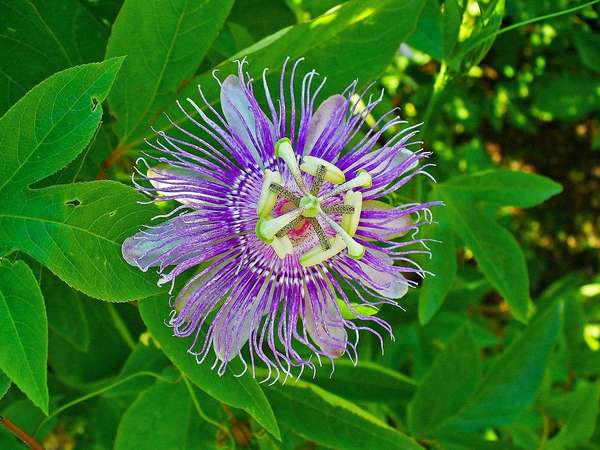 Passionflower (Passiflora incarnata). Photo © H. Zell, CC BY-SA 3.0.
Passionflower tea is produced from an infusion of the whole dried plant, including stems, leaves, root, and vine tendrils. The dried herb is also commonly included in herbal blends intended for medicinal use, usually those aimed to promote relaxation or reduce anxiety.
The passionflower plant also produces an edible fruit, called a maypop. The fruit lacks the strong medicinal properties of the herb; the fruit resembles the passionfruit, from the different species Passiflora edulis.
Medicinal effects for anxiety and other uses
The effect of passionflower tea is considerably stronger than that of more casual "relaxing" teas such as chamomile or lemon balm, and for this reason, we classify it as a wellness tea rather than an herbal tea for beverage use. There are also more safety concerns with this herb at common doses, which are discussed below.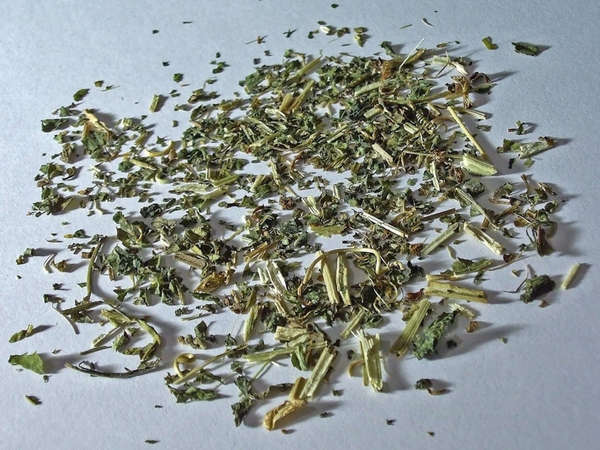
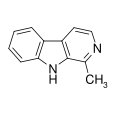
Harman, an alkaloid present in passionflower.
Passionflower, as the name suggests, has been traditionally used as an aphrodisiac, to increase sexual desire. There is evidence from a study on mice that passionflower can have an aphrodisiac effect.[3]
Passionflower is also used as a cough suppressant; a study on mice also found evidence supporting antitussive (cough suppressant) effects, similar to codeine.[4]
Safety and side-effects
According to WebMD's page on passionflower, passionflower is not safe for use during pregnancy because it can cause uterine contractions. WebMD lists dizziness, confusion, irregular muscle action and coordination, altered consciousness, and inflamed blood vessels as potential side effects. There is also a single case of serious toxicity that may be attributable to passionflower use.References:
1. Ali Movafegh et. al., Preoperative Oral Passiflora Incarnata Reduces Anxiety in Ambulatory Surgery Patients: A Double-Blind, Placebo-Controlled Study , Anesthesia and Analgesia, Vol. 106, No. 6, pp. 1728-1732.
2. 2. Kamaldeep Dhawan et. al. Attenuation of benzodiazepine dependence in mice by a tri-substituted benzoflavone moiety of Passiflora incarnata Linneaus: A non-habit forming anxiolytic., J Pharm Pharmaceut Sci, Vol. 6, No. 2, pp. 215-222, 2003.
3. Kamaldeep Dhawan et. al., Aphrodisiac activity of methanol extract of leaves of Passiflora incarnata Linn. in mice, Phytotherapy Research, Vol. 17, No. 4, pp. 401–403, April 2003.
4. Kamaldeep Dhawan et. al., Antitussive activity of the methanol extract of Passiflora incarnata leaves, Fitoterapia, Vol. 73, No. 5, August 2002, Pages 397–399.


