




Pu-erh Tea
Wikipedia: Pu-erh_tea | Teaviews: puer-teaLast Updated: Jul. 12, 2017
↑About Pu-erh Tea
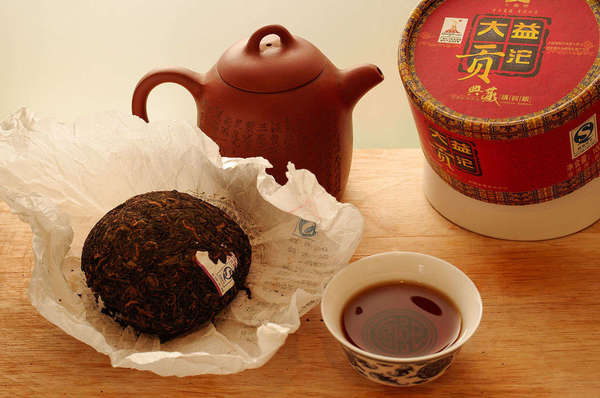 Shou (Ripened) Pu-erh from Menghai Tea Factory, showing a typical dark color. Photo © Copypaiste, Wikimedia Commons, CC BY-SA 3.0.
Although it can be consumed immediately after production, Pu-erh is often aged, in a process called post-fermentation. This process involves active bacteria and fungal cultures. In China, post-fermented tea is also called hei cha(黑茶), meaning black tea; what westerners call "black tea" the Chinese call "red tea".
Shou (ripened or black) vs. sheng (raw or green)
Pu-erh comes in fully oxidized varieties (a little like black teas), called shou or shu(熟), usually translated as ripe, ripened, or cooked pu-erh, and green varieties, called raw or sheng(生) pu-erh. Both ripe and raw versions can be aged, but the aging is more central to the raw teas, which are produced with a very strong flavor, intended to mellow with age. Originally, only the raw version was produced; ripe Pu-erh was developed to imitate the aging process.Sheng Pu-erh is frequently aged for very long time-periods. Sheng cakes in the 10-15 year age range are often still referred to as "young sheng".
Preferences for age and style of Pu-erh are largely a matter of personal taste. It is common for people to like only one or two of the classifications of fresh (unaged) sheng Pu-erh, young sheng, older sheng, or shou Pu-erh. Some people may find the strong flavors of fresh or young sheng to be objectionable, whereas other people find the aromatic qualities of older Pu-erh or shou Pu-erh to be unappealing. As the different ages and styles of Pu-erh can different considerably from each other, it is worth trying at least one example of the different ages and production types before drawing a conclusion about your opinion of Pu-erh as a whole.
Origins and production regions
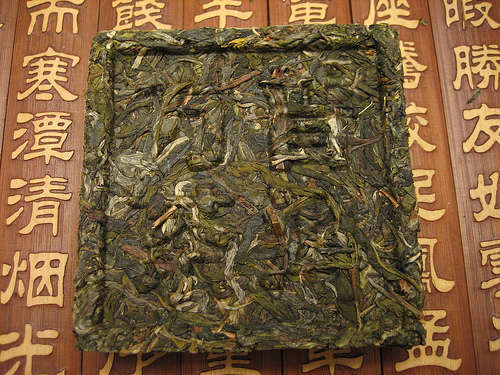 Raw Pu-erh typically shows a color more similar to that of green tea. Photo © Jason Fasi, CC BY-SA 2.5.
Within Yunnan, there are many important production regions. On RateTea, we classify these regions to the county level, when such information is provided by the seller. Important counties in Yunnan province include Fengqing, Menghai, Yongde, and Lancang (home of the Jing mai region).
Compressed vs loose-leaf
Unlike most teas which are usually sold loose, pu-erh is commonly sold both in loose and compressed forms. Pu-erh is compressed into different shapes, including bricks, cakes or disks (called bing or beeng), and a common form called tuo cha, which means bowl-shaped. These compressed teas must be broken apart prior to brewing, except for a few ones that are pressed into small single-serving shapes, like "mini tuo cha".Most of the highest-quality Pu-erhs, and most raw or sheng Pu-erhs are only available compressed into large cakes. Most of the loose-leaf Pu-erh on the market is ripened or cooked, and of relatively lower quality, and similarly, most of the single-serving compressed teas are also of lower quality.
Tea bags of Pu-erh, with a few exceptions, are usually ripened Pu-erh.
Health benefits of pu-erh tea
Pu-erh tea is often touted for its cholesterol-lowering properties, or for promoting weight loss. Experimental studies on rats have verified that it does lower cholesterol, by inhibiting the synthesis of cholesterol.[1][2] However, the chemicals, polyphenols, that inhibit cholesterol synthesis, GCG, EGCG, and other catechins[1], are not limited to pu-erh tea, but also occur in most types of tea, and are not necessarily highest in pu-erh. Similar results have been found for green tea.[3]Pu-erh also has also been found to have antimutagenic and antimicrobial activity.[4] However, other types of tea have these properties as well, and it has not yet been thoroughly established whether or not there are any health benefits or medicinal properties which are unique to Pu-erh.
Read more about the health benefits of tea.
New to Pu-erh?
Pu-erh can be intimidating and complex to get into. We recommend New to Pu'er? and Pu'er by Appearance: Types & Storage on bearsblog if you are interested in getting seriously into this type of tea.References:
1. Chi-Hua Lua, Lucy Sun Hwang, Polyphenol contents of Pu-Erh teas and their abilities to inhibit cholesterol biosynthesis in Hep G2 cell line, Food Chemistry, Vol. 111, No. 1, (Nov. 1, 2008), pp. 67-71.
2. Chiang, Chun-Te et al., Pu-erh Tea Supplementation Suppresses..., Oncology Research Featuring Preclinical and Clinical Cancer Therapeutics'', Vol. 16, No. 3, (2006), pp. 119-128(10).
3. C.A. Bursill, M. Abbey, P.D. Roach, A green tea extract lowers plasma cholesterol ..., Atherosclerosis. 2007 Jul;193(1):86-93.
4. She-Ching Wu et al., Antimutagenic and antimicrobial activities of pu-erh tea, LWT - Food Science and Technology, Vol. 40, No. 3, (Apr. 2007), pp. 506-512.
↑Recent Pu-erh Reviews — RSS 


Note: this was a sample included with my order. Aroma is as expected earthy/muddy strong. The liquor (5 min steep) is a very dark brown, with some purple. I would say classic Pu-erh smell. Strong boarding on dank. The taste is enjoyable and lingers on the palate. Interesting enough for me to want to investigate Pu-erh ...
Read Full Review
So, I am going to generalize with this review as there is not a lot going with this offering from Numi.
After breaking the first bar piece off I actually put this in the back of my cupboard, a few years later it has resurfaced, and I decided to give it a go.
No matter the water temp, steep time, serving temp (hot...

I recently ordered some tea and bulk herbs from iherb.com. This Numi pu erh brick was novel enough that I couldn't pass it up. I'll say up front that I'm not a huge fan of shou pu erh, but I've tried enough varieties at varying price points and even found some that I enjoy that I should at least be able to tell what I'...
Read Full Review
2016 Yunnan Sourcing "Red Monkey" Raw Pu-erh Tea Mini Cake from Yunnan Sourcing
Style: Raw (Sheng) Pu-erh – Region: Yunnan, ChinaMar. 20th, 2021
I ordered two of these in 2018 as it sounded from the description as the sort of thing I would like. I broke off a tiny piece initially, and as I expected it was a bit strong for my taste. I was surprised though at how quickly this one mellowed out.
Now, about 5 years from harvest, I broke off a bit again and it's s...

2016 Yunnan Sourcing "Red Monkey" Raw Pu-erh Tea Mini Cake from Yunnan Sourcing
Style: Raw (Sheng) Pu-erh – Region: Yunnan, ChinaMar. 20th, 2021
This pu-erh tea is wonderful! It has this rich vegetabley taste and it is thick bodied, almost like vegetable soup stock. Its really smooth and has no bitterness to it, its really enjoyable!
Read Full ReviewRead More Reviews of Pu-erh (106) ...
↑Top Reviewers
| Rank | User | # | % |
| 1 |  Alex Zorach Alex Zorach | 25 | 18 |
| 2 |  Amanda Amanda | 15 | 11 |
| 3 |  Alex Alex | 8 | 6 |
| 4 |  Whiskey Whiskey | 6 | 4 |
| 5 |  b22johansen b22johansen | 5 | 4 |
Review 6 teas to get on this list!
Advertisement
↑Most-Rated Pu-erh
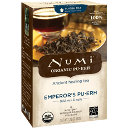
Emperor's Puerh - Black Tea
| Brand: | Numi Organic Tea |
| Style: | Pu-erh Tea |
| Region: | Yunnan, China |
| Caffeine: | Caffeinated |
| Leaf: | Teabag |
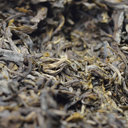
Xi Gui Ancient Tree Raw Pu-erh Cake 2013
| Brand: | TeaVivre |
| Style: | Raw (Sheng) Pu-erh |
| Region: | Yunnan, China |
| Caffeine: | Caffeinated |
| Leaf: | Loose |
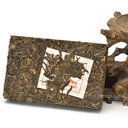
Fengqing Zhuan Cha Raw Puerh Brick Tea 2005
| Brand: | TeaVivre |
| Style: | Raw (Sheng) Pu-erh |
| Region: | Fengqing, Yunnan, China |
| Caffeine: | Caffeinated |
| Leaf: | Compressed |
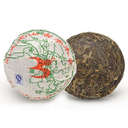
2006 Fengqing Raw Pu-erh Tea Tuocha
| Brand: | TeaVivre |
| Style: | Raw (Sheng) Pu-erh |
| Region: | Fengqing, Yunnan, China |
| Caffeine: | Caffeinated |
| Leaf: | Compressed |
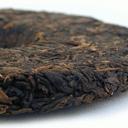
2005 Jing Mai Autumnal
| Brand: | The Tao of Tea |
| Style: | Ripened (Shou) Pu-erh |
| Region: | Lancang, Yunnan, China |
| Caffeine: | Caffeinated |
| Leaf: | Compressed |
↑Top-Rated Pu-erh
2006 Fengqing Raw Pu-erh Tea Tuocha
| Brand: | TeaVivre |
| Style: | Raw (Sheng) Pu-erh |
| Region: | Fengqing, Yunnan, China |
| Caffeine: | Caffeinated |
| Leaf: | Compressed |
Xi Gui Ancient Tree Raw Pu-erh Cake 2013
| Brand: | TeaVivre |
| Style: | Raw (Sheng) Pu-erh |
| Region: | Yunnan, China |
| Caffeine: | Caffeinated |
| Leaf: | Loose |
Emperor's Puerh - Black Tea
| Brand: | Numi Organic Tea |
| Style: | Pu-erh Tea |
| Region: | Yunnan, China |
| Caffeine: | Caffeinated |
| Leaf: | Teabag |
Fengqing Zhuan Cha Raw Puerh Brick Tea 2005
| Brand: | TeaVivre |
| Style: | Raw (Sheng) Pu-erh |
| Region: | Fengqing, Yunnan, China |
| Caffeine: | Caffeinated |
| Leaf: | Compressed |
2005 Jing Mai Autumnal
| Brand: | The Tao of Tea |
| Style: | Ripened (Shou) Pu-erh |
| Region: | Lancang, Yunnan, China |
| Caffeine: | Caffeinated |
| Leaf: | Compressed |


